Following the car ahead on a snowy road
Look at the picture, read the situation, and mark each of the three statements true (○) or false (✕). All three right scores 2 points.
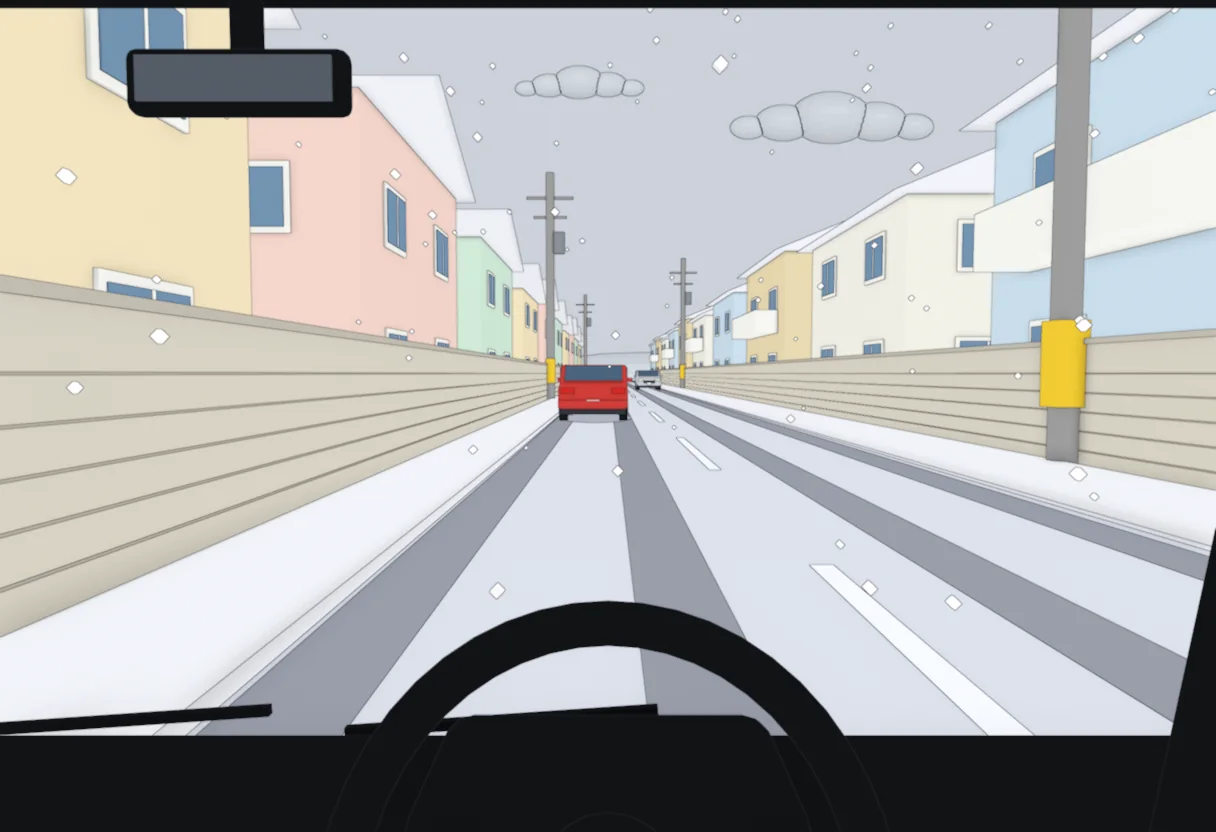
You are driving on a snowy road at 30 km/h. A thin layer of snow remains on the roadway, with wheel ruts in it. A passenger car is traveling ahead of you, some distance away. Answer true or false for each of the following.
- (1)Your normal following distance from the vehicle ahead is enough.
- (2)Hard braking causes skidding, so you use engine braking early.
- (3)Even when it is snowing, you press the accelerator hard and drive forcefully.
Show the answers and explanation
- (1) ✕ FalseYour normal following distance from the vehicle ahead is enough.
- (2) ○ TrueHard braking causes skidding, so you use engine braking early.
- (3) ✕ FalseEven when it is snowing, you press the accelerator hard and drive forcefully.
Explanation
Snowy roads are very slippery, so slow down well and keep plenty of following distance. Never start off suddenly, brake hard or steer sharply (Rules of the Road (kyōsoku), Ch. 6, Sec. 4, 2(2)). Do not use the brakes more than you need to; ease off the accelerator to lose speed gradually (Rules of the Road, Ch. 5, Sec. 4, 3(4)). Too much accelerator makes the drive wheels spin.
Source: Rules of the Road (kyōsoku), Ch. 6, Sec. 4, 2(2) (skidding on snowy roads) / Rules of the Road, Ch. 5, Sec. 4, 3(3) (no hard braking)