Merging onto the expressway main lanes
Look at the picture, read the situation, and mark each of the three statements true (○) or false (✕). All three right scores 2 points.
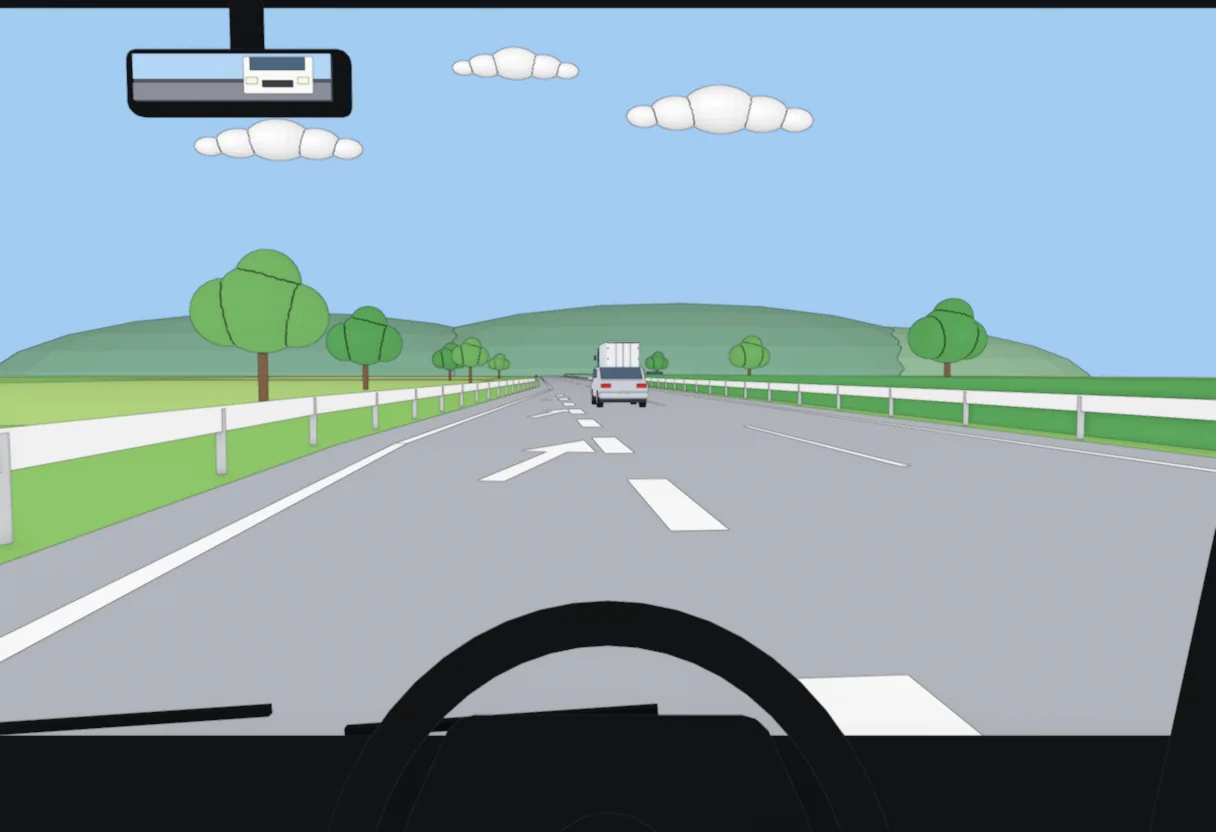
You are in the acceleration lane of an expressway, and the point where you merge onto the main roadway is in sight ahead. On the main roadway, a car is approaching from behind you, slightly to your right. Answer true or false for each of the following.
- (1)At the end of the acceleration lane, you slow down and wait for the vehicle on the main roadway before merging.
- (2)You confirm that no vehicle is closing in from behind, signal, and then merge.
- (3)The vehicles behind are hard to see, so you change lanes in one quick move without signaling.
Show the answers and explanation
- (1) ✕ FalseAt the end of the acceleration lane, you slow down and wait for the vehicle on the main roadway before merging.
- (2) ○ TrueYou confirm that no vehicle is closing in from behind, signal, and then merge.
- (3) ✕ FalseThe vehicles behind are hard to see, so you change lanes in one quick move without signaling.
Explanation
The principles of merging onto an expressway: accelerate to the speed of the main roadway in the acceleration lane (Rules of the Road (kyōsoku), Ch. 7, Sec. 2, 1(1)), do not obstruct vehicles on the main roadway (Rules of the Road, Ch. 7, Sec. 2, 1(2)), and signal 3 seconds before changing lanes (Road Traffic Act, Art. 53; Enforcement Order, Art. 21). Slowing down to merge, or merging without signaling, is a major cause of rear-end and side-swipe collisions.
Source: Rules of the Road (kyōsoku), Ch. 7, Sec. 2, 1(1) (accelerate to the speed of the main roadway) / Ch. 7, Sec. 2, 1(2) (vehicles on the main roadway have priority) / Road Traffic Act, Art. 53 and Enforcement Order, Art. 21 (signal 3 seconds before changing lanes)