Reversing to parallel park, with a bicycle approaching
Look at the picture, read the situation, and mark each of the three statements true (○) or false (✕). All three right scores 2 points.
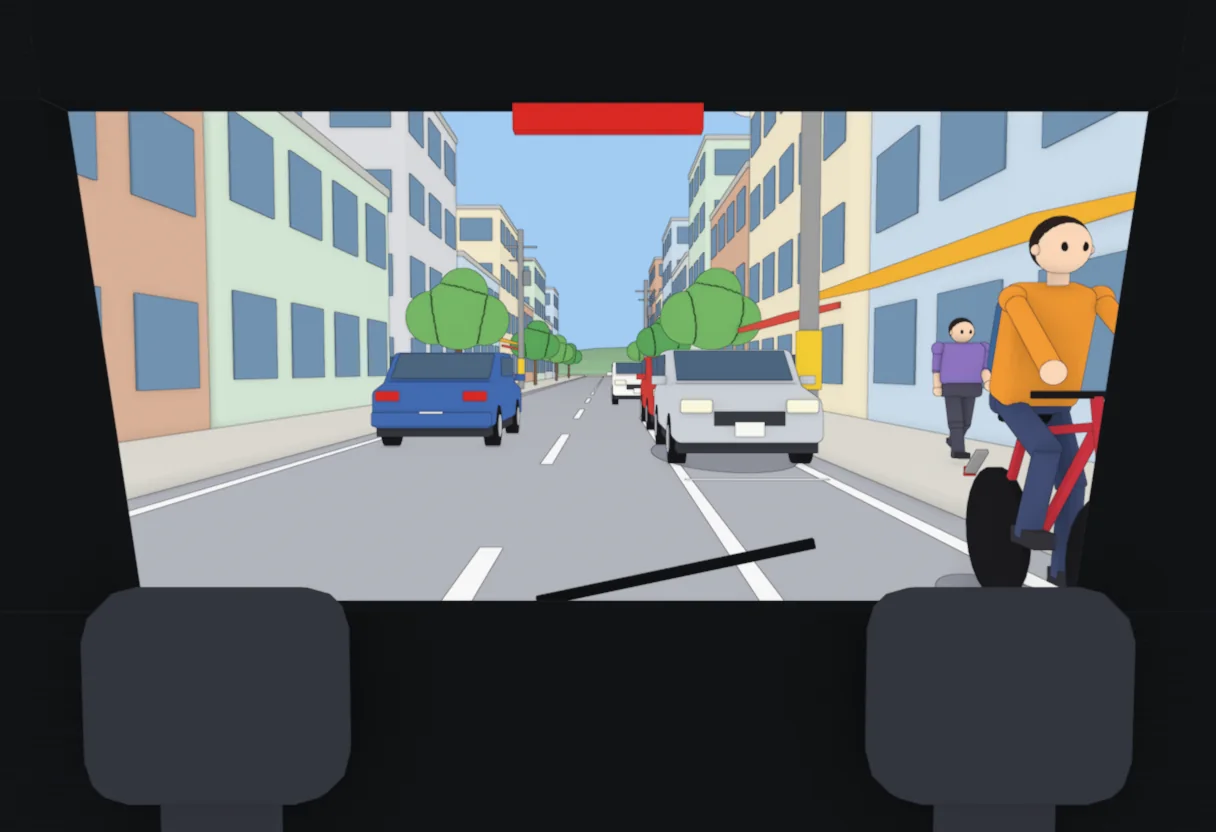
You are reversing to parallel park, with your right turn signal on and the steering wheel turned to the right. A bicycle is approaching from the left rear and is close to your blind spot. Answer true or false for each of the following.
- (1)You are concentrating on parking, and the bicycle will surely notice you and steer clear.
- (2)When reversing, you check all around you, 360 degrees, and move only after the bicycle has passed completely.
- (3)As long as your hazard lights are on, the bicycle behind you will stop.
Show the answers and explanation
- (1) ✕ FalseYou are concentrating on parking, and the bicycle will surely notice you and steer clear.
- (2) ○ TrueWhen reversing, you check all around you, 360 degrees, and move only after the bicycle has passed completely.
- (3) ✕ FalseAs long as your hazard lights are on, the bicycle behind you will stop.
Explanation
Reversing to parallel park leaves extremely wide blind spots, and it is easy to overlook a passing bicycle or pedestrian (Rules of the Road (kyōsoku), Ch. 5, Sec. 5, 3(1)). You must not reverse when doing so could obstruct a bicycle or other traffic (Road Traffic Act, Art. 25-2). Hazard lights mean 'stopped' or 'broken down'; they do not oblige vehicles behind you to stop.
Source: Rules of the Road (kyōsoku), Ch. 5, Sec. 5, 3(1) (reversing in tight spaces) / Road Traffic Act, Art. 25-2 (prohibition on crossing, U-turns and reversing)