Japan's 2026 Road Traffic Law Changes: 30 km/h Default, Cyclist Fines, Passing Bicycles and More
2026 was a busy year for Japan's traffic rules. The default speed limit on narrow residential streets dropped from 60 to 30 km/h, cyclists aged 16 and over can now be fined on the spot, drivers got a new duty when passing a bicycle, the driving test opened to people aged 17 and a half, and “drunk driving” gained a numeric definition. This article sets out what each change says, when it took effect, and where to read the rule itself. Every point below was checked against the text of the Road Traffic Act and its Enforcement Order as published on e-Gov, the Japanese government's law database, in November 2026.
The changes at a glance
- April 1, 2026 — A driver passing a bicycle without enough space must slow to a speed that is safe for that space. The cyclist must keep as far left as possible.
- April 1, 2026 — Cyclists aged 16 and over come under the traffic infraction notice system (the “blue ticket”), which means fixed fines for violations such as running a red light.
- April 1, 2026 — The driving test and the provisional license for ordinary and semi-medium vehicles open at 17 years and 6 months. The license itself is still issued from age 18.
- July 21, 2026 — “Driving while drunk” (sakeyoi) is defined with numbers for the first time: 0.5 mg of alcohol per liter of breath, or 1.0 mg per milliliter of blood.
- September 1, 2026 — The statutory speed limit for motor vehicles on ordinary roads with no center line and no lanes falls from 60 km/h to 30 km/h.
September 1: a 30 km/h default on roads with no center line
This is the change that affects the most drivers. Where no speed-limit sign is posted, the limit is the statutory speed set by Article 11 of the Enforcement Order. Until August 2026 that was 60 km/h for motor vehicles on every ordinary road, including a back street barely wide enough for one car. Since September 1, 2026 the Order splits ordinary roads into two groups.
- 60 km/h — ordinary roads that have a center line or traffic lanes marked, roads where the two directions are separated by the road's structure or by a fence or similar barrier, and motorways for motor vehicles only.
- 30 km/h — every other ordinary road. In practice these are the narrow streets through residential areas that have no center line.
Three points are easy to get wrong. First, a posted sign still wins: if a narrow street has a 40 km/h sign, the limit is 40, and if it has a 20 km/h sign, the limit is 20. Second, the change concerns motor vehicles. The statutory limit for mopeds was already 30 km/h and stays there. Third, nothing changes on national expressways, where the statutory limit on the main carriageway remains 100 km/h for ordinary cars.
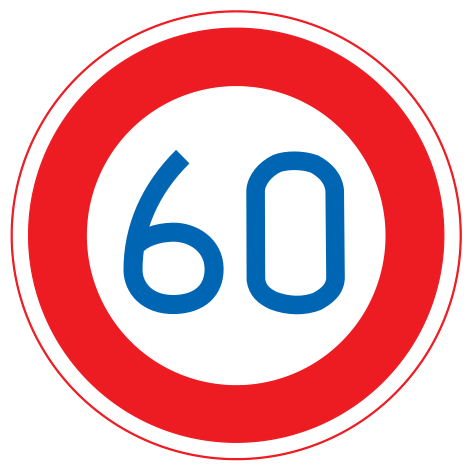
Do not exceed the posted speed (e.g. 60 km/h). Where no sign is posted, the statutory limit applies.
No sign and no center line: think 30. No sign but a center line or marked lanes: 60. A sign: whatever the sign says.
April 1: passing a bicycle
Article 18 of the Road Traffic Act gained two new paragraphs. Paragraph 3 covers a car or motorcycle that passes on the right of a bicycle travelling in the same direction. If there is not enough space between the two, the driver must travel at a safe speed that matches the space available. Paragraph 4 puts a matching duty on the cyclist, who must keep as close to the left edge of the road as possible while being passed.
- The rule protects bicycles and other light vehicles, and also specified small mopeds, the category that covers most electric kick scooters.
- It does not apply when the bicycle is on a sidewalk or a separate bicycle track.
- The Act gives no figure in meters or km/h. It asks for a speed that fits the gap: the narrower the gap, the slower you go.
- Pedestrians were already covered by paragraph 2 of the same article: keep a safe distance from them, or slow to a stop-ready speed (jokō).
- The fixed fine for the driver is 7,000 yen in an ordinary car and 6,000 yen on a motorcycle. For a cyclist who does not keep left it is 5,000 yen.
April 1: blue tickets for cyclists
Japan's traffic infraction notice system lets a driver settle a minor violation by paying a fixed fine, with no criminal procedure. Until 2026 it did not apply to bicycles, so the police could only warn a cyclist or open a criminal case. Since April 1, 2026 cyclists aged 16 and over are in the system. Riders under 16 are not, and are still dealt with mainly by guidance and warnings.
- The amounts are set by the Enforcement Order. Examples: 12,000 yen for holding and using a phone while riding, 6,000 yen for running a red light, and 5,000 yen for failing to stop at a stop sign.
- If the fine is paid within the deadline (provisional payment is open for 7 days from the day after the ticket), there is no criminal procedure. If it is not paid, the case moves to criminal procedure.
- Riding with alcohol in the body, and any violation that causes a traffic accident, are outside the blue-ticket system and go straight to criminal procedure.
For drivers the lesson is the same as before: a bicycle is a vehicle. It follows signals, stop signs and keep-left rules, and the test treats it that way. See the No Bicycles and Bicycles Only signs for how signs apply to cyclists.
April 1: the test opens at 17 years and 6 months
Until March 2026 you had to be 18 to take the test for an ordinary or semi-medium license, or to get the provisional license needed for on-road lessons. The Act now allows both from 17 years and 6 months. The minimum age for holding the license has not moved: a person who passes before turning 18 receives the license once they are 18.
July 21: a number for “driving while drunk”
Japanese law has two alcohol offences. The lighter one, driving with alcohol in the body (shuki-obi), has long had a numeric threshold: 0.15 mg per liter of breath. The heavier one, driving while drunk (sakeyoi), used to be defined only as a state in which the driver might be unable to drive normally, which had to be shown from how the driver walked, spoke and behaved.
Since July 21, 2026, Article 117-2 of the Road Traffic Act states that a driver with 0.5 mg or more of alcohol per liter of breath, or 1.0 mg or more per milliliter of blood, is in that state. A driver under those figures can still be found drunk if alcohol has left them unable to drive normally. The penalty is imprisonment for up to five years or a fine of up to one million yen. The rule for learners has not changed and is still the simplest one to follow: if you drink, you do not drive, and you do not ask someone who has been drinking to drive.
Earlier changes you will still hear about
- October 2025 — The knowledge test for converting a foreign license became 50 true/false questions with a 90% pass line. See what changed in October 2025.
- November 2024 — Using a phone while cycling and cycling with alcohol in the body became punishable offences.
- July 2023 — Specified small mopeds (most electric kick scooters) became a category of their own: no license needed, riders must be 16 or older, helmets encouraged.
- April 2023 — All cyclists are asked to make an effort to wear a helmet.
What this means if you are studying for the test
The knowledge test is written from the Rules of the Road, the textbook issued by the National Police Agency. As of November 2026 the edition on the Agency's website is still the one dated November 13, 2024, so it does not yet describe the changes that took effect in 2026. When the textbook and the current law differ, the law is what applies on the road.
- Learn the statutory speeds as a pair: 60 km/h with a center line or lanes, 30 km/h without. Our practice questions on speed in Chapter 5 (driving method) follow the Enforcement Order as it stands now.
- Treat “a safe distance, or slow down” as one idea that covers both pedestrians and bicycles.
- Older study material and videos made before September 2026 will still say that the default on ordinary roads is 60 km/h everywhere. Check the date of anything you study from.
- Terms such as jokō and specified small moped are explained in the glossary.
Try the 50-question practice test for the foreign license conversion, or the road sign quiz.